News
Reuters Unmasks Banksy-for Better or Worse
Sunday 29 March 2026
Reuters has earned plaudits and brickbats for an extensive investigation that claims to have proven beyond doubt the true identity of the anonymous British street artist known as Banksy, and discovered that he changed his name almost two decades ago to continue to "hide in plain sight".
The online exposé by three Reuters journalists ran to 8,000 words, lavishly illustrated with photos, (CNN called it “sprawling”) and reaped an avalanche of pick-ups around the world as well as a host of follow-on stories and commentary from outlets that included publications as diverse as The New York Times, artnet and the World Socialist Web Site.
But the article also unleashed anger and dismay from both commentators and members of the public, with much of the backlash accusing Reuters of violating Banksy’s privacy and putting him at risk of arrest, given that much of his anti-establishment graffiti is technically illegal.
Many critics, including some veteran journalists, also questioned why Reuters had devoted so much time and effort to the story, given serious constraints on resources, when there were so many important stories in the world to investigate and report, from the crimes of sexual predator Jeffrey Epstein to the U.S.-Israeli war with Iran.
The year-long investigation, which ran on March 13 titled In Search of Banksy, took the reporters to a bombed-out village in Ukraine and to London and New York, where a search of court records unearthed a handwritten confession signed in 2000 by one Robin Gunningham following his drunken arrest for defacing a rooftop billboard in downtown Manhattan.
The reporters also said they had established that in 2008 Gunningham, a now 52-year-old from Bristol in southwest England, changed his legal name to David Jones – one of the most common names in Britain – to stay under the radar.
Reuters said the elusive Banksy did not reply to detailed questions about the findings or his work and quoted his lawyer, Mark Stephens, as saying that Banksy “does not accept that many of the details contained within your enquiry are correct.”
Much of the coverage prompted by the Reuters article focused on its impact on Banksy’s distinctly subversive street art, with the art world seemingly divided as to whether knowing his identity would make the multimillionaire artist’s prized works less or more valuable.
“Banksy may see himself as a rebel, but he’s become part of the established art market, so the more known about his life, the better,” one New York gallerist, Jean-Paul Engelen, told the Wall Street Journal. “It doesn’t diminish his artistic adventures.”
But among the critics, The Guardian said in an editorial that an artist’s decision to remain anonymous should be respected. “Whether as a protection from prosecution or a highly successful publicity stunt, his anonymity has become integral to the iconoclastic Banksy brand,” it wrote.
Even The Sun – a UK tabloid not known for holding back – said it drew the line. “Banksy is an icon, not a greying middle-aged man with glasses. So having never stepped into the limelight, why should we in the press try to drag him into it screaming?” Sun reporter Alex West asked.
Reuters, in the article and an associated podcast, said it had withheld personal details about Banksy out of respect for his privacy but concluded that the public had a “deep interest” in understanding his identity and career, given his global celebrity and cultural influence.
That cut no ice with Banksy fans, hundreds of whom “absolutely eviscerated” one of the Reuters reporters, investigative projects editor Blake Morrison, in an online chat with him on the social platform Reddit, according to one account.
Given the importance of anonymity to Banksy’s appeal, the Associated Press quoted one Banksy fan as saying the Reuters decision to puncture his mystique was akin to being told without warning that Santa Claus does not exist.
But others simply shrugged, noting that The Mail on Sunday had identified Banksy as Gunningham as far back as 2008.
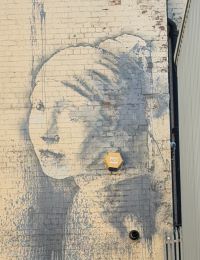
Photo shows Banksy's "Girl with a Pierced Eardrum" in Bristol, which he created in 2014. It's a parody of "Girl with a Pearl Earring" by Johannes Vermeer. ■
- « Previous
- Next »
- 7 of 2187